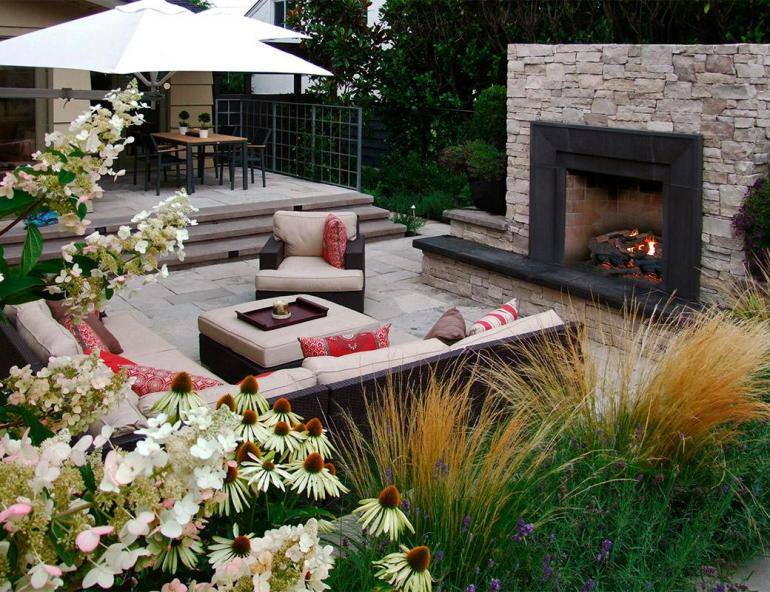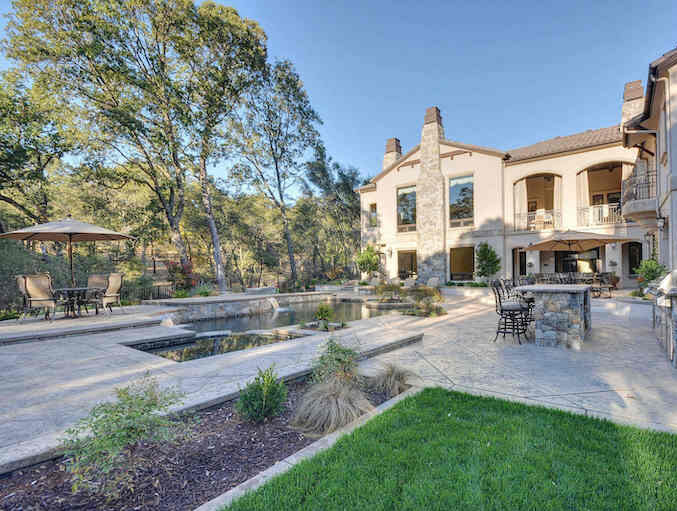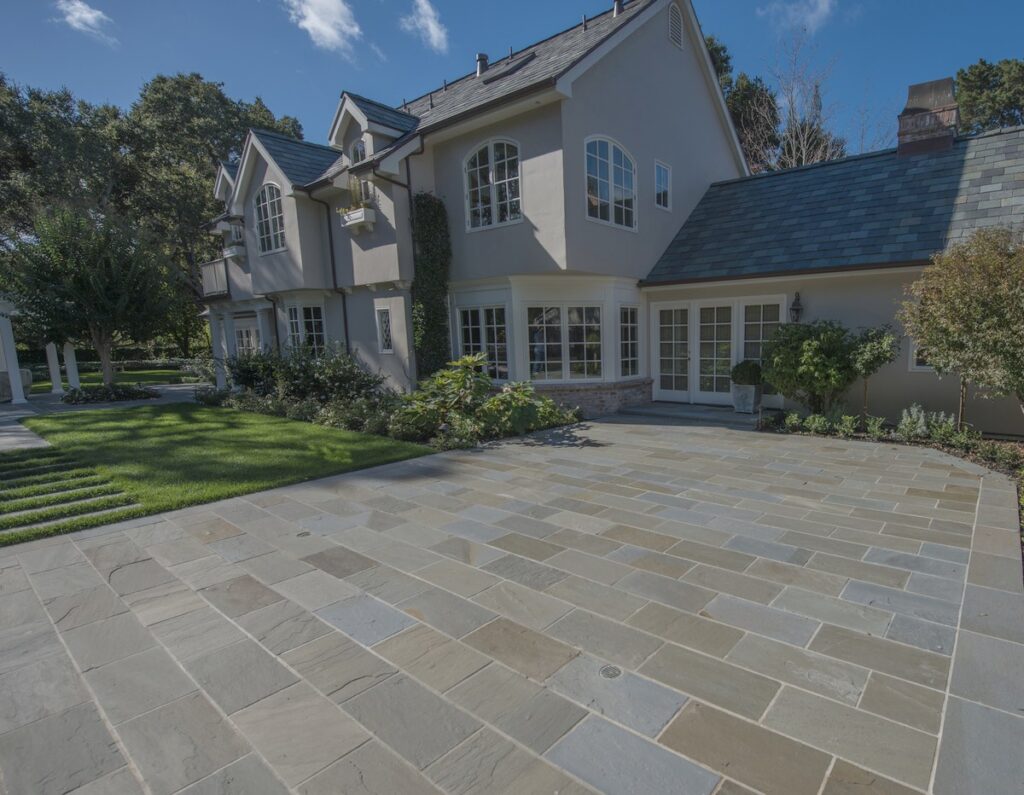
Pavers are more than just a building block for a pathway or driveway; they manage water, carry loads, set the visual tone, and determine how a space feels underfoot. In the Bay Area, add seismic movement, clay soils, coastal air, and stormwater rules to the equation, and the right choice becomes even more important. This guide distills the essentials so you can specify or select confidently, and it spotlights several new pavers now available at PBM: Mod7, Permeable Mission, Permeable Plank, SF RIMA, and Dimensions Slab.

1) What kind of pavers are suitable for which application?
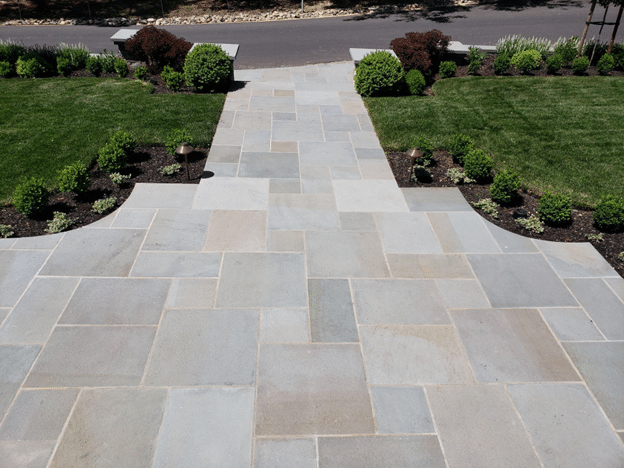
Pictured Above: Bluestone (Full Range Flamed) Dimensional Paving
Pedestrian paths & patios
- Best fits: Pre-cast interlocking concrete pavers (ICPs) or natural stone pavers 1¼”–2¼” thick on a compacted base.
- Why: Stable, safe walking surface; patterns (running bond, herringbone) resist creep on slopes and at edges.
- Pro tips: Use polymeric sand or permeable joints for easy maintenance; choose textures that provide slip resistance when wet.
Pool decks
- Best fits: Light-colored ICPs or natural stone with low heat absorption (limestone, light granites), slip-resistant finishes.
- Why: Comfort underfoot and safer wet traction; lighter colors mitigate heat island effects.
Driveways (light residential)
- Best fits: 60–80 mm (≈2⅜”–3⅛”) interlocking concrete pavers over a properly engineered base. Select smaller or modular units rather than huge slabs.
- Why: The interlock spreads vehicular loads; smaller units reduce risk of corner cracking.
Courtyards & plazas (light vehicle access or service lanes)
- Best fits: 80 mm ICPs or stone set on a reinforced base; permeable systems when stormwater capture counts.
- Why: Higher thickness handles occasional loads; permeable sections can meet stormwater goals without adding drains.
Steep walks & hillside terraces
- Best fits: Interlocking modules with textured surfaces and good edging restraints.
- Why: Pattern interlock resists downslope creep; edging resists lateral movement.

2) Natural Stone Pavers vs. Pre-Cast Interlocking Concrete
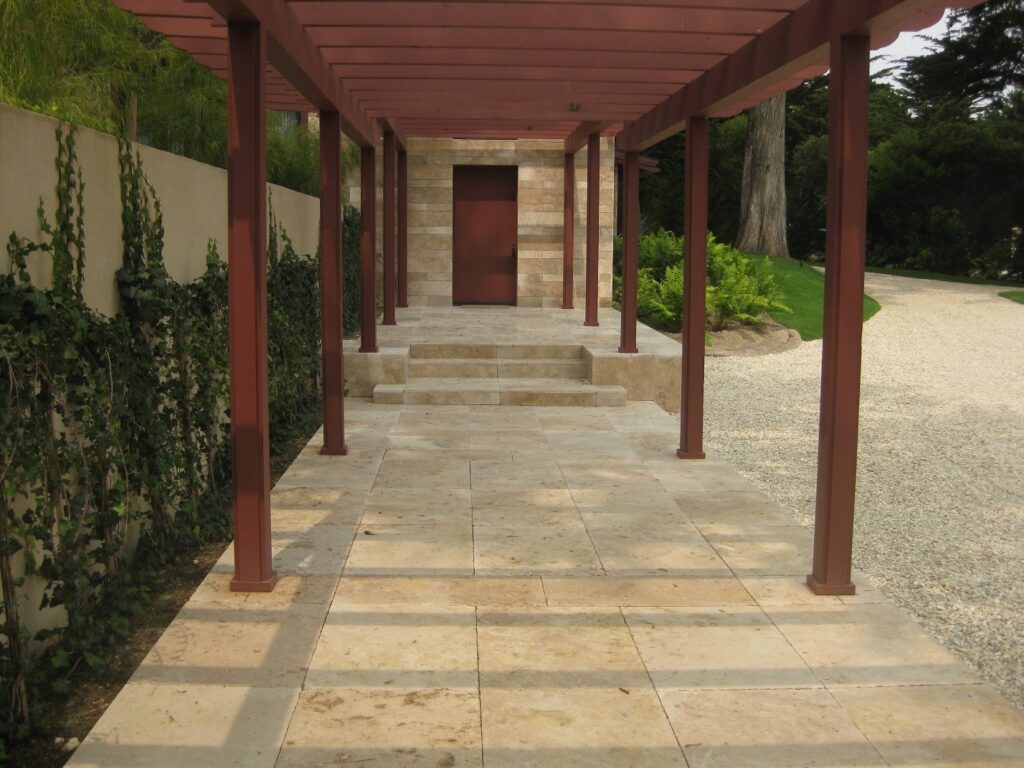
Pictured Above: Cremino Travertine Pavers
Natural Stone
- Strengths: Timeless look, unique color variation, excellent longevity; many stones weather beautifully.
- Considerations: Dimensional tolerances vary; larger formats may require thicker sections and a stiffer base to avoid cracking; can be heavier to handle; cost is often higher.
- When to choose: Premium design intent, historic or custom aesthetics, or when you need distinct textures and veining.
Pre-Cast Interlocking Concrete (ICPs)
- Strengths: Tight dimensional control; proven structural interlock; wide palette of colors, textures, and modular sizes; typically easier and faster to install; many systems are vehicular-rated.
- Considerations: Color uniformity can be more consistent (a pro or con depending on design); expect normal concrete color evolution over time.
- When to choose: Driveways, permeable installations, modern modular layouts, projects needing predictable performance at scale.

3) Sizes of Pavers by Application
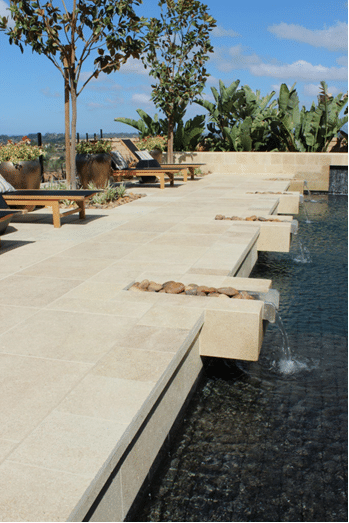
Pictured Above: Brushed Prairie Shell Limestone Paving + Coping
- Walkways & patios (pedestrian):
Modules from 6″x12″ up to 24″x24″ work well. On curves or slopes, prefer smaller units (4″x8″, 6″x9″) for smoother arcs and better interlock.
- Pool decks:
12″x24″, 16″x24″, or modular patterns with joints under ⅜” for comfort; choose non-slip finishes.
- Driveways (residential):
Stick with interlocking modules such as 4″x8″, 6″x9″, or mixed bundles. Thickness ≥60 mm (often 80 mm for steeper slopes/heavier vehicles).
- Large terraces/plazas:
Larger slabs (24″x24″, 24″x36″) can look stunning, but use them in pedestrian zones or ensure engineering for vehicular loads if required.
4) How large can driveway pavers be—and why?
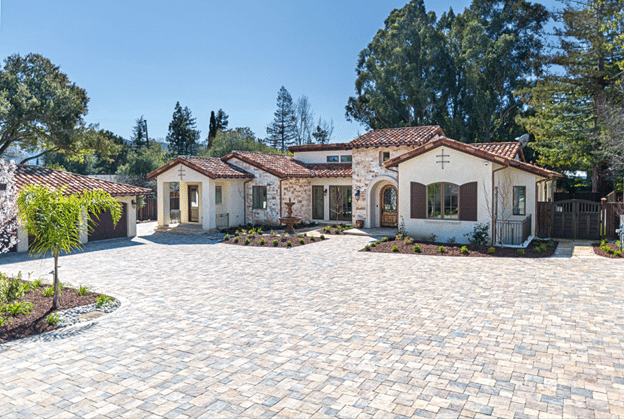
Pictured Above: Quarry Stone Pavers
For vehicular areas, the rule of thumb is: smaller modules = better load distribution. Large-format slabs concentrate stress at corners and along edges, increasing the chance of cracking or rocking unless you:
- increase thickness substantially,
- enhance the base (thicker, well-graded aggregate, or rigid setting),
- and maintain excellent edge restraint.
Most residential driveways perform best with smaller interlocking units (60–80 mm thick) in patterns like herringbone or 90° running bond, which maximize interlock and resist turning stresses from tires. If the design insists on a larger look, consider modular systems that visually read as large panels but are actually composed of interlocking smaller pieces.

5) What are permeable pavers?

Pictured Above: SF Rima Permeable Pavers
Permeable interlocking concrete pavers (PICP) are designed with enlarged joints or spacer lugs. Rainwater passes through the joint aggregate into an open-graded stone base that stores, filters, and gradually releases water to the subgrade or drains. Benefits:
- Stormwater compliance: Can reduce or replace conventional drains, easing permit pathways in many Bay Area jurisdictions.
- Flood mitigation & groundwater recharge: Lower peak flows and encourage infiltration.
- Water quality: Joint and base aggregates help trap sediments and some pollutants.
- Maintenance: Vacuum-sweep periodically to keep joints free-draining.
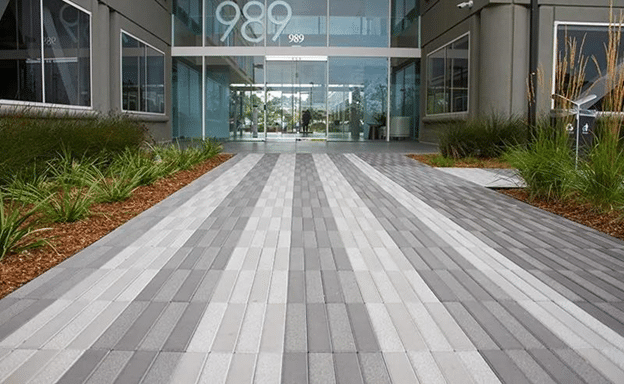
Pictured Above: Permeable Plank Pavers
Good candidates: Driveways, parking bays, courtyards, and walkways where runoff reduction is a goal. Ensure the subgrade infiltration rate and local codes support PICP—or include underdrains where needed.

6) How slope angle affects paver selection
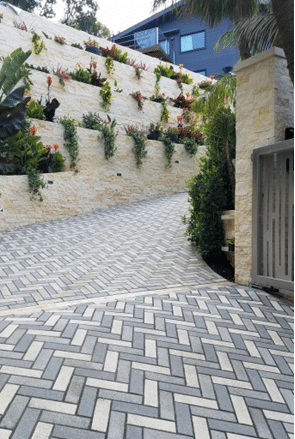
Pictured Above: Ackerstone Aqualina Pavers
- Pedestrian safety: Use textures with higher slip resistance as slope increases. Reduce joint widths to limit heel catch and lateral creep.
- Pattern choice: Herringbone offers superior resistance to downslope movement for both pedestrians and vehicles.
- Edge restraint & banding: Strong edge restraints and transverse banding (rows set perpendicular to slope) help lock fields in place.
- Permeable systems on slopes: In general, the steeper the slope, the more attention you must give to check dams in the base, compartmentalizing the section so water doesn’t race downslope within the reservoir. If slopes are significant, consult an engineer and local stormwater guidance for allowable gradients and detailing.
- Base prep: On slopes, expect thicker base sections, careful compaction, and potential use of geotextiles/geogrids depending on soils.

7) New (and Noteworthy) Pavers at PBM
- Mod7
Three paver sizes (7”x14”, 14”x14”, 14”x21”) + a border of 7”x10” that are available in a combo pack. These are larger format pavers with an 80mm thickness that are suitable for residential driveways as well as walkways, pathways, and decks.
- Permeable Mission – Special Order Only*
Classic Mission-style aesthetic with permeable performance—ideal when you want old-world charm without sacrificing stormwater goals.
- Permeable Plank – Special Order Only*
Linear, board-like proportions that create sleek, modern lines while still allowing infiltration through engineered joints—excellent for walkways and design-forward residential driveways.
- SF RIMA – Special Order Only*
A proven permeable interlocking system with spacer geometry that supports either drainage or turf-joint applications. A solid choice for driveways, parking strips, and high-function landscapes.
- Dimensions Slab
Large-format slabs with crisp dimensional tolerances for premium pedestrian surfaces. Perfect for courtyards, roof decks (with pedestal systems), and upscale patio zones. For vehicular use, consult specs—most large slabs are for pedestrian areas unless specially engineered.

8) Quick-Reference Selection Matrix
| Application | Material Type | Typical Thickness | Go-To Sizes | Notes |
| Walkways & Patios | ICPs or Stone | 1¼”–2¼” (stone), 60 mm ICP | 6″x12″ to 24″x24″ | Smaller modules ease curves; textures for slip resistance |
| Pool Decks | Light-tone ICPs or Stone | 1¼”–2¼” | 12″x24″, 16″x24″ | Cooler colors; fine textures; sealed to ease maintenance |
| Driveways | ICPs (preferred) | 60–80 mm | 4″x8″, 6″x9″ | Herringbone or running bond; strong edge restraint |
| Plazas/Courtyards | ICPs or Stone | 60–80 mm ICP or thicker stone | Mixed modular | For service lanes, upsize thickness and base |
| Permeable Zones | PICP Systems | 80 mm common | Modular permeable units | Design base reservoir, underdrains as needed, plan maintenance |
| Sloped Areas | ICPs with texture | 60–80 mm (vehicular) | Smaller modules | Add banding/check dams; robust edge restraint |

9) Bay Area-Specific Tips
- Soils & seismic: Many Bay Area sites have expansive clays. A well-graded, compacted base and geotextile separation can improve long-term performance. Segmental systems also tolerate minor ground movement better than monolithic slabs.
- Stormwater rules: Municipalities often favor solutions that reduce runoff. Permeable systems (Permeable Mission, Permeable Plank, SF RIMA) can help meet project goals—verify local requirements and coordinate early.
- Coastal exposure: Choose finishes and sealers compatible with salt-air conditions, and specify stainless or non-corroding edge components where applicable.

10) Spec Checklist (Copy/Paste for Your Next Project)
- Use & loads: Pedestrian only? Light vehicles? Service trucks?
- Format & thickness: Choose modules and ≥60 mm for driveways (often 80 mm on slopes/heavier use).
- Base design: Depth, gradation, separation layers, and drainage (underdrain for PICP as needed).
- Jointing: Polymeric sand (impervious) vs. permeable aggregate.
- Edge restraint: Continuous, anchored, and appropriate to the base type.
- Slope detailing: Pattern selection (herringbone), banding, check dams for permeable builds.
- Maintenance plan: Vacuum sweeping for permeable joints; periodic sand top-up for ICPs.
- Aesthetics: Color, texture, and pattern mock-ups; integrate accents/borders for wayfinding and scale.

Ready to choose?
Visit PBM to see Mod7, Permeable Mission, Permeable Plank, SF RIMA, and Dimensions Slab in person, compare textures and colors under natural light, and discuss base and detailing options for your exact site conditions. If you share your load, slope, and stormwater goals, we’ll help dial in the optimal system and specification.