(and How to Do It Right)
Walk into a Bay Area design firm right now and you’ll probably spot a sample on the table that wasn’t there five years ago. It’s a piece of natural stone, usually warm and tactile, sometimes cool and grey, and often headed for a fireplace. Designers and architects from Palo Alto to Tiburon have quietly stopped reaching for painted brick and tile-look-everything. They want materials with more texture, weight, and character.
We see the same shift from the other side of the counter. Homeowners who used to come into our Mountain View showroom asking for “something clean and modern” are now asking for something with a little more warmth to it. If you’re renovating a fireplace or building a new one, you’re not imagining the change. The fireplace is becoming a focal point again, and natural stone is a big part of that. So let’s talk about why it’s happening, how to pick stone that won’t feel dated in a few years, and four stones we’ve been recommending a lot lately.
What’s actually changed about how Bay Area homes are getting designed
A few things are driving it.
First, there’s material fatigue. A decade of drywall, painted brick, oversized tile, and the same subway tile on every fireplace has run its course. The Bay Area went all-in on minimalism, partly because of tech-money modernism and partly because so much of our housing stock got remodeled during the open-plan years. A lot of those rooms ended up feeling a little flat. Stone adds texture and depth in a way paint can’t, and that’s exactly what a lot of open-plan rooms have been missing.
The other thing to consider is longevity. A natural stone fireplace built today can outlast the house. The Natural Stone Institute, which sets the durability standards the industry uses, points out that natural stone is one of the few materials that actually improves with age. In places like Italy and the American Southeast, it’s lasted hundreds of years in active use. Cultured stone, painted brick, and tile don’t hold up the same way. Once you start thinking in decades instead of trend cycles, your priorities shift.
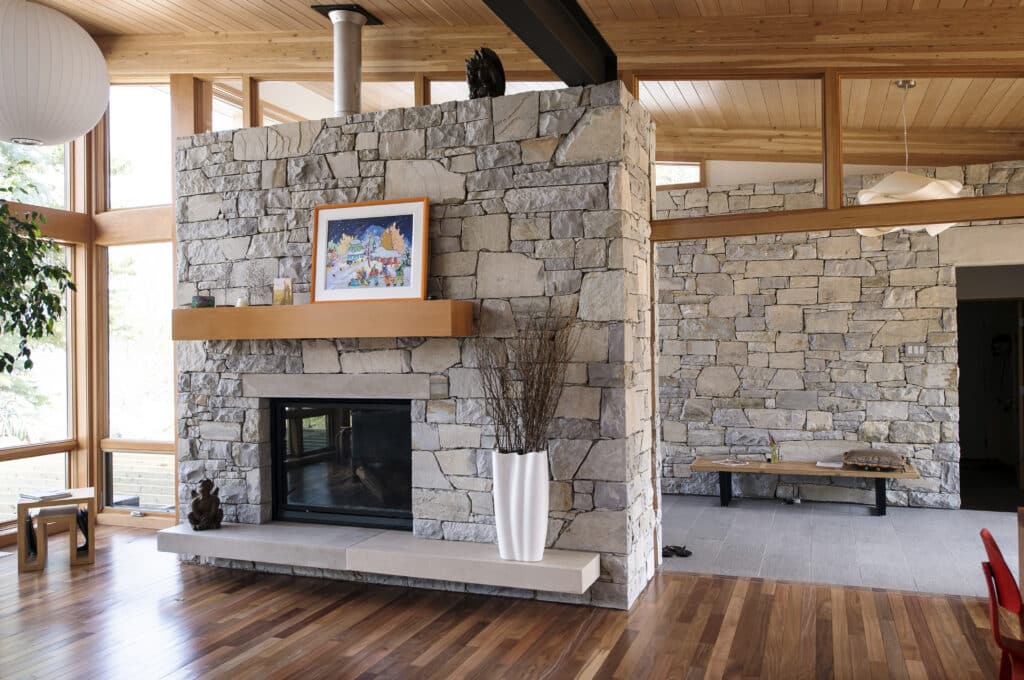
And then there’s the move toward what some designers call warm minimalism. Bay Area homes still lean clean and simple, but people want that simplicity to feel warm instead of cold. Wide-plank oak floors, plaster walls, and one textured element like a stone fireplace can read as modern and warm at the same time. Stone ended up being the material that bridges both. You can see it in stone-fireplace round-ups from material specialists like Polycor, where even the most contemporary projects are often anchored by a single warm or textured stone wall.
How to choose stone that won’t feel dated in five years
Most fireplace mistakes happen when the stone gets picked before the room is figured out. Here are three things to think about.
Start with the room, not the rock
It’s a lot easier to start with the look you want than with a specific stone. If you walk in thinking “I need limestone,” you’re kind of starting in the middle. Start with the house instead. Coastal modern, Spanish revival, mid-century, Napa rustic, classic Peninsula traditional: each style tends to point you toward certain stones. Once you know the look you’re going for, the choices get a lot simpler. We wrote a deeper guide to choosing the perfect stone for your fireplace if you want more detail, but the short version is to pick the feel first, then the stone.
Indoor versus outdoor changes how you choose
The same stone can behave differently inside and outside. Outdoor fireplaces have to deal with weather, like rain, sun, and the freeze-thaw cycles you get in the higher hills, so you want stone with a proven outdoor track record. That’s especially true in the Bay Area, where conditions change a lot from the coast to the East Bay. Indoor fireplaces can handle more delicate stones, but they look best when the finishes and grout lines are consistent and the lighting shows off the texture. If you’re doing a covered patio or a backyard setup, you’ve got even more options. Some of our favorite outdoor projects pair a stone fireplace with a fire feature, which we covered in our cozy backyard retreat post.
Thin veneer versus full-bed
Most Bay Area remodels use thin veneer. It’s usually about an inch thick and goes right onto your existing framing, so you don’t have to rebuild the wall behind it. Full-bed stone is heavier and deeper, and it’s typically used in new construction or load-bearing walls. Once it’s installed, the two look very similar if the stone is good, but the install cost is pretty different. Unless you’re building from scratch, ask about thin veneer first.
Four natural stones we keep coming back to
These are the four we’ve been recommending most this year, grouped more by overall feel than technical stone type.
Plaza Gold: for warm, classic-Peninsula traditional
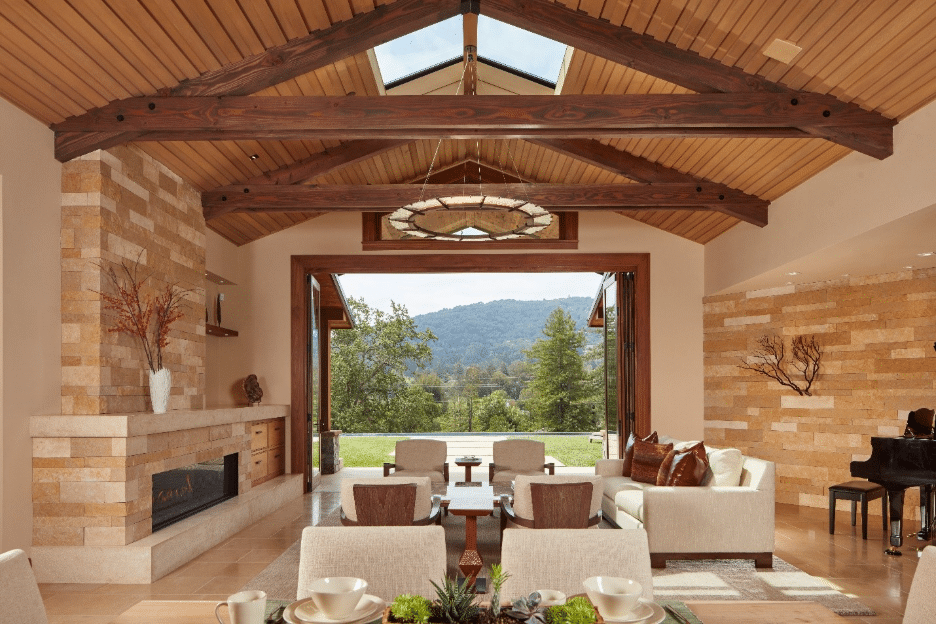
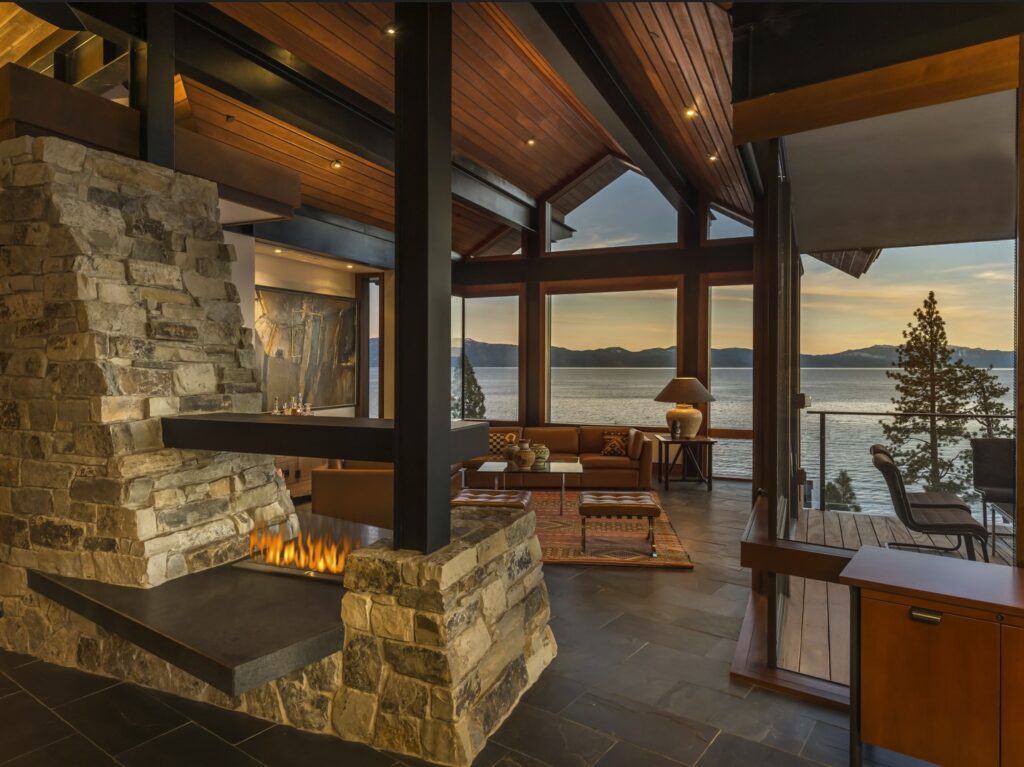
If you want a fireplace that feels warm and settled, Plaza Gold limestone is a great place to start. It’s a European limestone with gold, tan, and beige tones and a fossil-rich texture that looks really nice in afternoon light. It works as a full fireplace wall in a living room with wood beams and an open kitchen behind it, and it also works well on patios and pool decks if you want the same stone inside and out. We see Plaza Gold most often in homes that are formal but not stuffy, like vaulted-ceiling great rooms and hillside houses with big views, where the fireplace has to hold its own next to a wall of windows.
Ocean Pearl: for coastal-modern and Bay-view homes
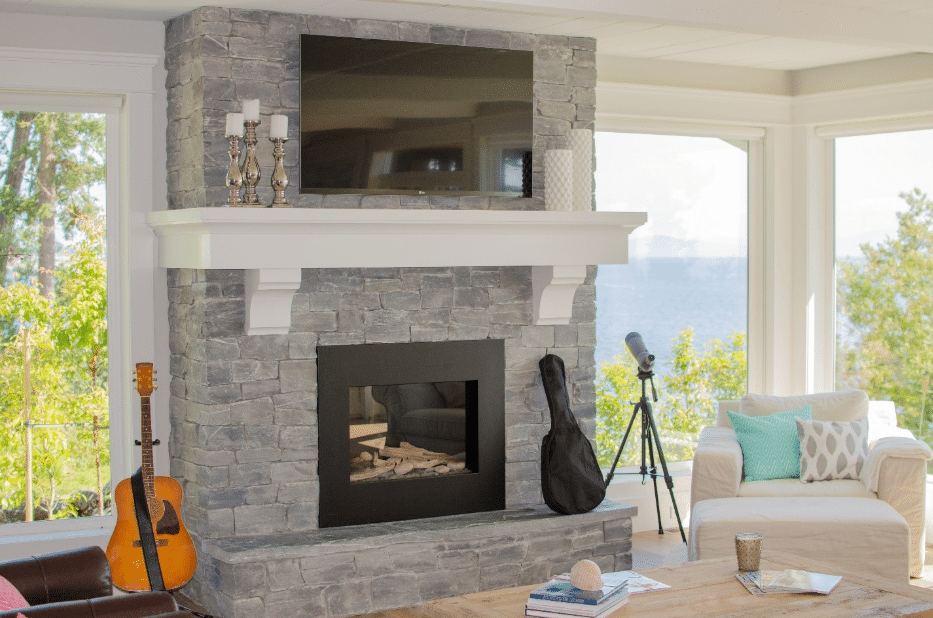
Ocean Pearl is the one we recommend when the house has a view you don’t want to compete with. It has soft, cool tones with a subtle pearl shimmer, so it stays calm next to a wall of glass. It comes as thin veneer for walls and as boulders for landscape work. We’ve seen it used in coastal-modern living rooms where everything else is white-on-white and the only real color is the ocean outside. The stone helps ground the space without taking it over. If the architecture is already doing the talking and you want the fireplace to sit quietly inside it, this is a good pick.
Tundra Cream: for Mediterranean, Spanish revival, and white-stucco houses

Tundra Cream rubble is a Texas limestone with creamy tones and a rough, irregular shape. It’s a rubble stone that looks hand-laid, because it basically is. It’s a natural fit for Mediterranean and Spanish revival homes, white-stucco exteriors with terracotta roofs, and outdoor courtyards with olive trees and string lights. We see it most often as an outdoor fireplace stone, or as an exterior accent that shows up again at the entry to tie the front and back of the house together. Indoors, it brings a warm, rustic feel that a lot of other limestones miss. It looks great with plaster, wood beams, and tile.
Willow Creek: for Napa rustic and indoor-outdoor great rooms
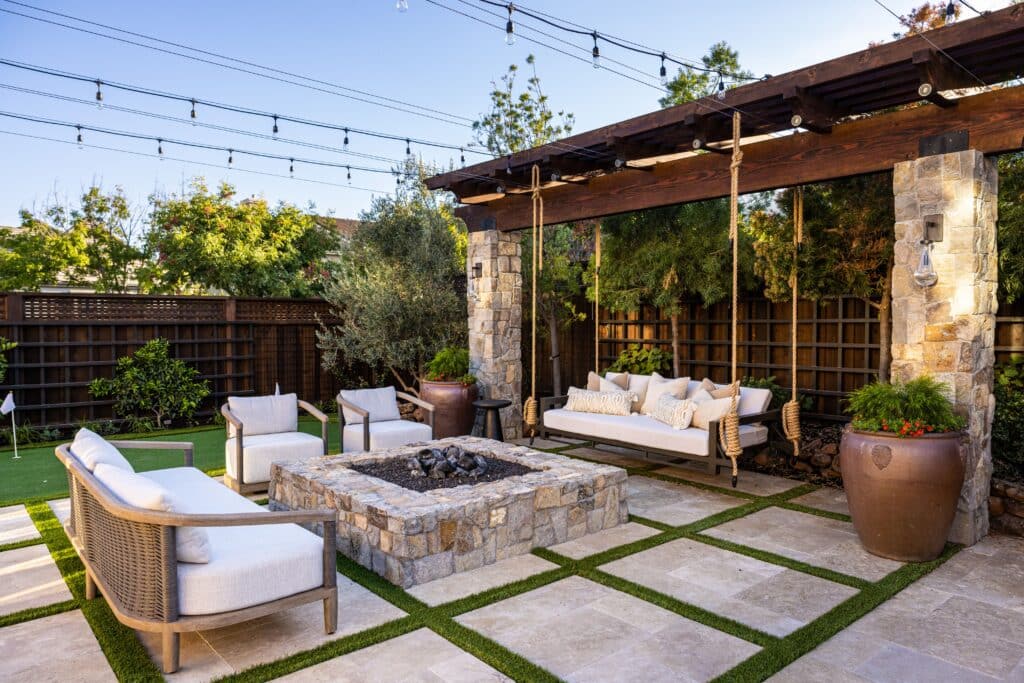
Willow Creek is the stone we point to when someone’s building a Napa-style house, and that’s a lot of houses right now. It’s a volcanic basalt and rhyolite from the Napa Valley. It feels especially at home in Napa-style architecture because it naturally fits the landscape and tones you see there. You get creamy beiges, dove greys, and rosy undertones, with a texture that deepens over the years. We’ve used it for outdoor fireplaces, retaining walls, winery entries, and the stone pillars on indoor-outdoor patios where the same stone has to work as both a fireplace and part of the structure. It comes as fieldstone, thin veneer, and boulders, so you can keep the same look from the front gate to the back wall.
What about heat and maintenance?
Two practical questions that come up a lot.
On heat: limestone, basalt, granite, and most natural stones used around fireplaces hold up fine in normal home use, inside or out. There are a few exceptions, like some marbles and softer sandstones, but those aren’t stones we’d put near a firebox anyway. If you’ve got an active wood-burning fireplace that gets a lot of use, ask us what we’d recommend for the area closest to the firebox, and make sure your fireplace’s clearance specs are followed.
On maintenance: there’s not much to it. For natural stone veneer on a fireplace, you’re mostly just dusting it indoors or giving it an occasional rinse outdoors. We usually tell homeowners not to seal a fireplace. Part of what makes natural stone great is the patina it builds up over time, and sealing works against that by keeping the stone from breathing and aging naturally. Sealing definitely has its place, like on pavers and high-traffic surfaces where it helps with damp-proofing, but a fireplace wall usually isn’t one of those spots. If you’ve got a question about a specific stone, that’s a good thing to ask us about. The Use Natural Stone project from the Natural Stone Institute also has easy-to-read care guides if you want more.
Choosing fireplace stone is really about how you want the room to feel
Honestly, picking fireplace stone isn’t really about R-values or which material is technically denser. It’s more about what you want to walk into on a Saturday morning and how you want your home to feel down the road.
If you’re getting close to picking a stone, or you’re a designer working through it for a client, come see us at our Mountain View showroom. We’ve got full-scale fireplaces, patios, and house fronts built right on the floor, so you can see the stone in real light instead of guessing from a photo. Our team can pull samples for you to take home and walk you through the four stones in this piece.
That’s really what we’re here for: someone who works with this stuff every day helping you make the call. The stone itself is the easy part.
FAQ
Is natural stone really safer for an active fireplace than cultured stone or painted brick?
In normal home use, both natural stone and good-quality cultured stone are rated for use around fireplaces, so this is really about looks and longevity more than safety. Natural stone tends to age better and hold its detail over the years, without the chipped or peeling-paint look that some finished options get. For an active wood-burning fireplace, just make sure the manufacturer’s clearance specs are followed no matter which material you go with.
Do natural stone fireplaces need a lot of maintenance?
Not really. For natural stone veneer on a fireplace, a little dusting indoors or an occasional rinse outdoors is usually all you need. We generally don’t recommend sealing a fireplace. The patina that natural stone builds up over time is part of its character, and letting it breathe and age naturally is a good thing. Sealing makes sense for some uses, like pavers or high-traffic surfaces where it helps with damp-proofing, but a fireplace wall usually isn’t one of them. If you’ve got a question about a specific stone, our showroom team can help, and the Natural Stone Institute’s Use Natural Stone resource has easy-to-read care guides.
Should a fireplace stone go floor-to-ceiling?
It depends on the room. Floor-to-ceiling stone makes more of a statement and looks great in rooms with high ceilings, where a half-height stone wall can look a little small. In rooms with eight- or nine-foot ceilings, a partial-height stone wall with a wood mantel and a painted wall above it often looks more balanced. Either way works with natural stone, so it really comes down to the style and scale of the room.
Visit Peninsula Building Materials’ Mountain View design center to see all four stones (Plaza Gold, Ocean Pearl, Tundra Cream, and Willow Creek) in full-scale installations on the showroom floor. Yards in Redwood City, Santa Clara, San Martin, and Livermore. Serving Bay Area homeowners and designers since 1923.